Mary Shelley's Frankenstein: A Winter's Tale of Creation and Isolation
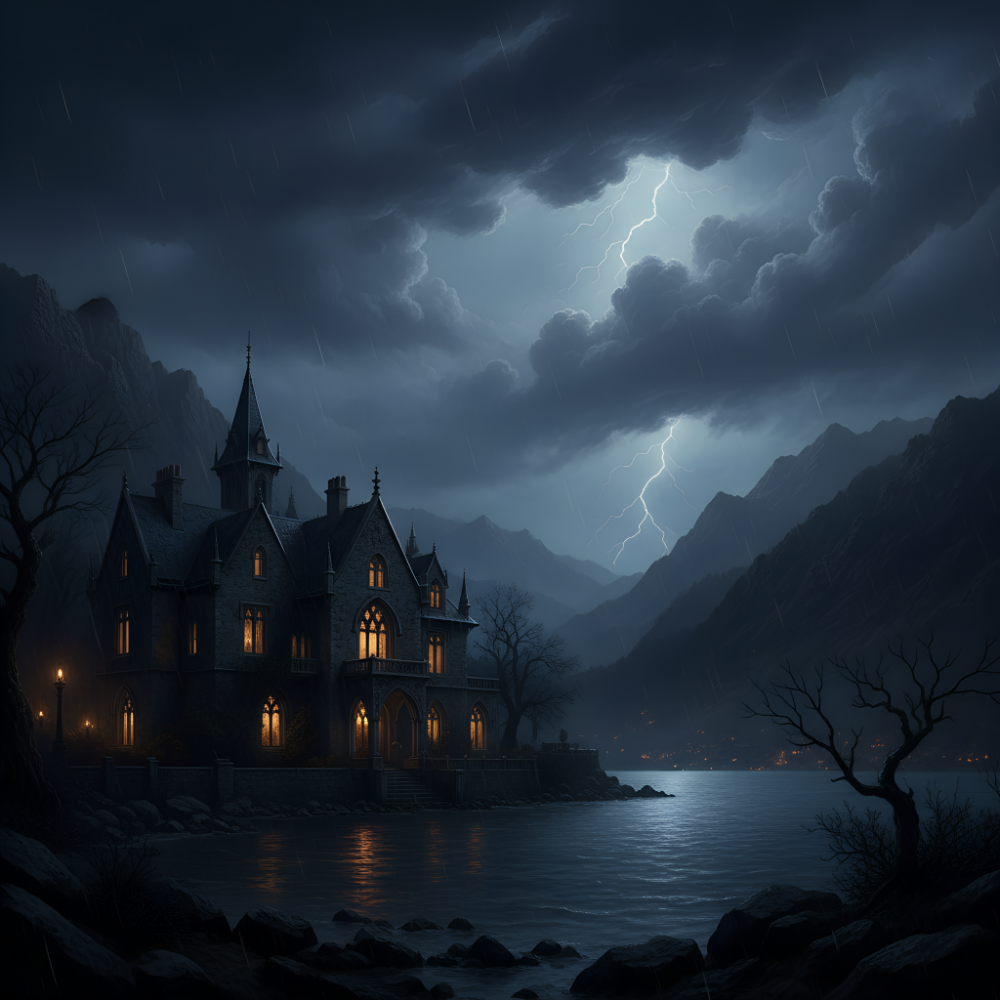
The sky refused to clear. Across Europe, snow fell in June, frost killed the crops, and the sun hung pale and sickly behind a veil of volcanic ash drifting from the other side of the world. In this cursed summer of 1816—later christened "the Year Without a Summer"—a group of young Romantics found themselves trapped by ceaseless rain in a villa overlooking Lake Geneva. What else could they do but tell ghost stories?
Among them sat an eighteen-year-old woman, recently bereaved, living in scandal, and surrounded by some of the era's most celebrated literary minds. She would, in the span of a few fevered months, produce a novel that none of those brilliant men would ever surpass. Frankenstein; or, The Modern Prometheus emerged from the storm-wracked gloom of that lost summer, and its questions about creation, abandonment, and what truly makes a monster have refused to stop haunting us since.
A Volcano's Shadow
Before we speak of ghosts and monsters, we must speak of fire—specifically, the catastrophic eruption of Mount Tambora in Indonesia in April 1815. It was the largest volcanic event in over a thousand years, hurling so much ash and sulfur into the stratosphere that the resulting aerosol cloud rivaled the size of Australia. Global temperatures plummeted. Crops failed from New England to Scandinavia. Historians would later call it "the last great subsistence crisis in the Western world."
The consequences rippled outward in ways both tragic and strange. Famine. Migration. Economic collapse. And, on the shores of a Swiss lake, a group of young English expatriates found themselves trapped indoors by rain that seemed determined never to end.
The Villa Diodati Circle
The guest list at Villa Diodati reads like a who's-who of Romantic excess. Lord Byron—already Europe's most scandalous poet—had rented the villa as a summer retreat. His personal physician, the brooding John Polidori, accompanied him. Nearby lodged Percy Bysshe Shelley, the radical poet, with his young partner Mary Godwin (they weren't yet married) and her stepsister Claire Clairmont, who was carrying on an affair with Byron himself. It was all terribly dramatic.
Mary, at eighteen, was the youngest of the group. She carried her own weight of sorrow: her mother, the feminist philosopher Mary Wollstonecraft, had died giving birth to her. Her first child, a premature daughter, had lived only weeks. Her father, the celebrated philosopher William Godwin, had disowned her for running off with a married man. Yet here she sat among titans, often describing herself as "a devout but nearly silent listener" during their philosophical debates.
Fun Fact Cauldron:
John Polidori's contribution to Byron's ghost story challenge became The Vampyre (1819)—predating Bram Stoker's Dracula by nearly eighty years and establishing the suave, aristocratic vampire archetype we still recognize today.
The Challenge
The rain hammered the windows. Lightning split the darkness over the lake. Byron, ever theatrical, proposed an entertainment: each member of the party would write a supernatural tale.
Percy Shelley, reportedly, became so disturbed by the atmosphere that he fled the room in terror during one particularly intense discussion. Byron began a fragment about a vampire that would later inspire Polidori's more successful attempt. And Mary? Mary struggled. Days passed without inspiration striking.
Then came the night of June 16th.
The conversation that evening had turned to galvanism—the fashionable scientific theory that electricity might animate dead tissue. Experiments of the era had demonstrated how electrical currents could make corpses twitch and spasm, leading some to speculate that the secret of life itself might be electrical in nature. The implications were intoxicating and terrible.
That night, Mary experienced what she later called "a waking dream." She described the vision in vivid terms: "I saw the pale student of unhallowed arts kneeling beside the thing he had put together." The image that seized her imagination was not the moment of creation, but what came after—the creator's horror at what he had made, his desperate flight, and the awful awakening when he opens his eyes to find "the horrid thing stands at his bedside, opening his curtains, and looking on him with yellow, watery, but speculative eyes."
The ghost story had arrived.
Birthing the Monster
It would take Mary nearly a year of what she called "ferocious writing and revision" to transform that single nightmare into a complete novel. The timing was poignant: the manuscript's development roughly paralleled the nine months of human gestation. For a young woman who had already experienced the devastating loss of an infant, the parallels between artistic and physical creation must have felt almost too apt.
Frankenstein was published anonymously in 1818—readers assumed a man had written it, and many initially attributed it to Percy Shelley. When Mary was revealed as the author, the accomplishment seemed almost impossible. How could a girl of eighteen have produced something so philosophically rich, so structurally ambitious, so profoundly unsettling?
Fun Fact Cauldron:
The novel has never been out of print since its original publication. Stage adaptations began appearing as early as 1823—just five years after the book was first released.
The God Who Ran Away
Fundamentally, Frankenstein is a story about parenthood gone catastrophically wrong.
Victor Frankenstein spends years obsessed with unlocking the secrets of life. He haunts charnel houses, collects body parts, labors in solitary frenzy in his laboratory. His goal is god-like: to create a living being from dead matter. And he succeeds. But the moment his creation opens its eyes, Victor experiences not triumph but revulsion. The creature is too large, its skin too translucent, its features too uncanny. Victor flees in horror, abandoning his creation to navigate a hostile world without guidance, language, or love.
This is Victor's true crime—not playing God, but refusing to stay and be a parent.
The creature awakens innocent. He has no language, no understanding of human society, no malice in his heart. Over time, teaching himself to read and speak by secretly observing a cottage family, he develops extraordinary intelligence and emotional depth. He longs desperately for connection. But every approach toward humanity is met with screaming and violence. Villagers drive him away with stones. The family he loves recoils in terror.
"I was benevolent and good," the creature tells Victor. "Misery made me a fiend."
Two Kinds of Isolation
Both Victor and his creation suffer profound loneliness, but their isolations operate by different mechanisms.
Victor's solitude is self-chosen. He retreats into his laboratory—which Mary calls "a solitary chamber, or rather cell"—cutting himself off from family, friends, and society in pursuit of his obsession. This voluntary isolation allows his ambition to metastasize unchecked. No one can counsel him toward prudence. No one can question whether he should do what he increasingly demonstrates he can do.
The creature's isolation, by contrast, is imposed upon him. He desires nothing more than human connection—to be seen, to be accepted, to be loved. His request to Victor is not for world domination or even freedom, but simply for a companion: another being like himself who might understand his unique suffering. Victor refuses out of fear.
As the novel progresses, something curious happens. The creature becomes increasingly humanized-eloquent, reasonable, even pitiable. Victor, meanwhile, becomes progressively frozen, obsessed, consumed by hatred. By the final Arctic chase, it's no longer clear which of them is the monster.
Made, Not Born
The question Frankenstein poses most urgently is whether monstrosity is innate or constructed.
Mary Shelley's answer is unequivocal: we are made, not born. The creature enters the world without malice. When he discovers the poverty of the family he secretly observes, he stops taking food from their stores, demonstrating an innate benevolence no one taught him. His capacity for language, for philosophy, for love—all develop naturally despite having no nurturing environment.
Yet every gesture toward connection is punished. Kindness is answered with violence. Attempts at communication are met with screaming. The creature learns, over bitter years, that he will never be accepted. His goodness curdles into rage.
Compare this to Victor, who was born into privilege, loved by his family, educated at the finest institutions. He had every advantage of nurture—and squandered it all through narcissism and moral cowardice. Victor's monstrosity emerges not from deprivation but from plenty unaccompanied by ethical reflection.
Ritual Reads Recommends:
Paradise Lost by John Milton—The creature teaches himself to read using this epic poem, and the parallels between Milton's Satan and Shelley's creation are no accident. A perfect companion text for understanding the novel's theological dimensions.
The Modern Prometheus, Unbound
Victor Frankenstein's very subtitle—"The Modern Prometheus"—signals the novel's engagement with questions of ambition and transgression.
Prometheus, in Greek myth, stole fire from the gods and gave it to humanity. For this act of rebellious generosity, he was eternally punished. But here's the crucial distinction: Prometheus acted for humanity's benefit. Victor acts only for his own glory. His pursuit of the secret of life is narcissism dressed up as science—the desire to "surpass what is known," to be celebrated as history's greatest genius.
Science without ethics, Mary Shelley suggests, is not progress but catastrophe.
Written at a moment when genuine scientific advances seemed to promise wonders—galvanism, chemistry, the industrial revolution churning into motion—Frankenstein functions as a warning. The question is never simply can we? but always should we? Victor never pauses to consider the welfare of the being he creates. He never asks what kind of life awaits a creature so unprecedented. He thinks only of the achievement, never of the responsibility.
Who Deserves the Name?
Mary Shelley never once calls the creature a "monster" in the original text. That word is applied only by characters within the story-and, later, by the popular adaptations that simplified her nuanced vision into something more comfortable.
The creature commits terrible acts. He murders innocents. This cannot be excused. But consider: Victor's choices create the conditions for every tragedy. He abandons his creation. He allows innocent people to be executed for the creature's crimes rather than confess the truth. He refuses to make a companion who might have given the creature peace. His moral cowardice, his narcissism, his pathological inability to take responsibility—these are the seeds from which all horror grows.
Both are monsters. Both are victims. The novel refuses to let us find an easy answer.
Lightning Still Strikes
Two centuries on, Frankenstein has become perhaps our culture's most versatile metaphor for creation gone wrong.
When scientists debate the ethics of artificial intelligence, they invoke Victor's relationship to his creation: What do we owe the conscious beings we might one day make? When CRISPR gene-editing technology enabled researchers to modify human embryos, the specter of Frankenstein haunted every ethics committee. When synthetic biologists created the first artificial cell, media coverage was saturated with references to the novel.
The book's questions have, if anything, grown more urgent. We stand at the threshold of technologies that might genuinely create new forms of life—or consciousness, or intelligence. Mary Shelley's warning echoes through the laboratories: creation without ethical forethought, without accepting the full weight of responsibility for what we bring into being, leads only to tragedy.
Fire from the Cold
From a volcanic winter that starved continents, from rain that wouldn't end, from a young woman's grief and a ghost story challenge proposed to pass the time—Frankenstein emerged.
The irony is delicious: while Byron's vampire fragment and Percy Shelley's philosophical fragments faded into footnotes, the "nearly silent listener" produced a novel that would outlast them all. Mary Shelley, at eighteen, captured something essential about human ambition and human failure—our capacity to create wonders and our reluctance to tend what we've made.
Frankenstein reminds us that the coldest seasons, literal or metaphorical, can spark the most enduring fire. Whatever we create—in laboratories, in art, in the quiet chambers of our own ambition—we remain responsible for. That is the burden Victor Frankenstein could not bear. That is the lesson his creature, with all his terrible eloquence, tried desperately to teach.
The storm over Lake Geneva has long since cleared. The novel it birthed remains, waiting, patient as any monster, for the next reader to open the curtains and meet its speculative yellow eyes.
Stay connected with Ritual Reads
Be the first to hear about newly conjured titles, upcoming gatherings, and curated recommendations from our shelves.
Community voices
What our future community is saying.