
The Gothic Origins of A Christmas Carol: How Dickens Blended Horror and Hope
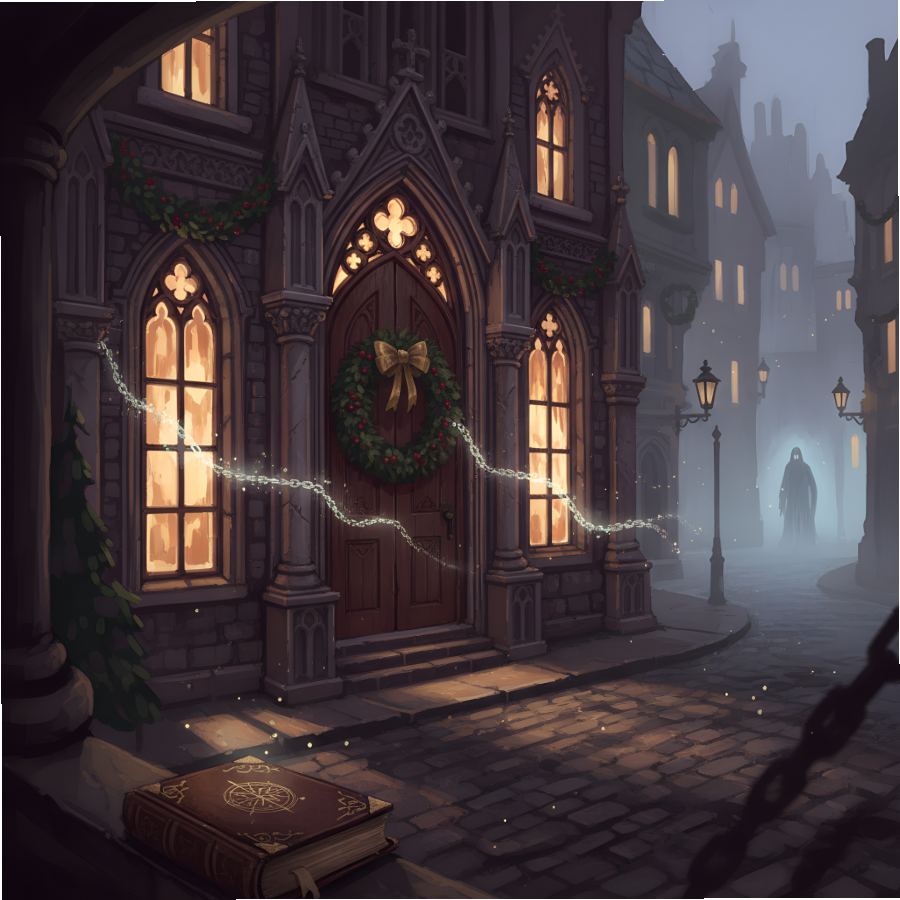
Here's a paradox that would've delighted Dickens himself: A Christmas Carol is one of the most comforting holiday stories we have, and it's also a full-on ghost story with disembodied chains, graveyard visions, and supernatural terror. The miser Scrooge doesn't get his heart warmed by cocoa and carolers. He's terrified into transformation by spectral visitors who drag him through memory, poverty, and death itself.
Victorian readers would've immediately recognized the novella as part of a robust Christmas ghost story tradition—a cultural habit of gathering around the fireside during the long winter nights to share tales of the uncanny. But Dickens didn't just write a festive morality tale. He blended gothic horror with radical hope, weaponizing the supernatural to force Scrooge (and his readers) to confront uncomfortable truths about greed, isolation, and social inequality.
So why does this work? Why does a story about a miserable old man being psychologically tormented by the undead make us feel good? Because Dickens understood something we're still figuring out: sometimes you need to scare people into caring. What follows is a journey through Victorian Christmas hauntings, Dickens' personal demons, the fog-choked gothic atmosphere of his London, and the four spirits who drag Scrooge kicking and screaming from terror to joy. Spoiler alert: it's going to get dark before it gets light.
Ghosts at the Fireside
If you think ghost stories belong to Halloween, you're about a century late to the party. In Victorian Britain, telling ghost stories at Christmas was as common as hanging mistletoe. Frigid temperatures and long December nights made the season ideal for sharing tales of the supernatural. Writer Jerome K. Jerome captured this perfectly in his 1891 anthology Told After Supper: "Nothing satisfies us on Christmas Eve but to hear each other tell authentic anecdotes about specters."
Shakespeare, Marlowe, and the OG Winter Tales
The tradition had deep roots. Shakespeare referenced "stories of spirits and goblins" told during winter in Winter's Tale (1623), and Marlowe mentioned "winter tales" of ghosts in The Jew of Malta (1589). But it was the Victorians who turned it into a cultural institution. The practice emerged from pre-Christian solstice festivals when winter was viewed as a time when "the veil between the world of the living and dead is most thin."
By the mid-19th century, magazines regularly ran ghost stories in their Christmas issues, and Dickens himself used his periodicals—All the Year Round and Household Words—to promote the genre. He published Christmas ghost stories featuring contributions from literary celebrities like Elizabeth Gaskell and Wilkie Collins. A Christmas Carol (originally titled "A Ghost Story of Christmas") became the most famous example of this tradition, inextricably bound to the heritage of holiday ghost stories in Britain.
Dickens' Ghostly Side Hustle
Dickens didn't just stumble into the genre. Beyond A Christmas Carol, he wrote "The Story of the Goblins Who Stole a Sexton" (1836), The Chimes (1844), and The Haunted Man and the Ghost's Bargain (1848). The man loved a good haunting—especially when it came wrapped in holly and ribbon.
Dickens' Personal Hauntings
To understand why Dickens wielded horror so effectively, you need to know what haunted him. As a child, Dickens experienced poverty firsthand when his father was imprisoned for debt. Young Charles was forced to work in a blacking factory, an experience so humiliating that he kept it secret until after his death. By early 1843—the year he wrote A Christmas Carol—Dickens had witnessed children working in appalling conditions in a tin mine and visited a ragged school where neglected children languished without education or hope.
For Dickens, "social horror" was as terrifying as any supernatural specter. The "ghosts" of hunger, ignorance, and neglect were the true monsters haunting Victorian London. The New Poor Law of 1834—which Scrooge references when charity workers approach him—was deliberately designed to be so forbidding that workhouses became places of last resort. Dickens himself called it the most "infamously administered" law since the days of the Stuarts.
So when Dickens conjured literal ghosts in A Christmas Carol, he wasn't just writing a spooky tale. He was using the gothic as a vehicle for social critique, embodying moral and social consequences in spectral form. The chains Marley drags aren't just scary—they're the accumulated weight of a life spent prioritizing profit over people. That's horror with teeth.
Fun Fact Cauldron:
Victorian "warning ghosts" were a popular literary device in which spirits intervened in the lives of the living to deliver urgent messages about mortality and morality. These ghosts functioned as catalysts for character transformation—exactly what Marley does for Scrooge.
Gothic London
Before the ghosts even arrive, Dickens sets the scene with a London that feels less like a city and more like a living, breathing haunted house. The novella opens not with festive snow and carols, but with fog—industrial smog so thick it pours "in at every crevice and keyhole." The streets are shadowy, the air oppressive, and the darkness seems to have a presence of its own.
This is classic gothic atmosphere: claustrophobic, liminal, alive with menace. Dickens employs pathetic fallacy to link Scrooge's internal state to the external world. The fog becomes a symbol of the miser's spiritual blindness, the cold mirrors his emotional frigidity, and the emptiness of his "gloomy suite of rooms" echoes his isolation. His chambers are described as "echoey and empty of humanity," lit by flickering candles that cast more shadows than light.
The counting-house where Scrooge works is a study in gothic minimalism: narrow, dark, suffocating. Meanwhile, the Cratchit home—cramped though it is—radiates warmth and life. Dickens contrasts oppressive interiors with moments of cozy domesticity, making Scrooge's solitude feel even more punishing.
Threshold Terrors
And then there are the liminal spaces: doorways, thresholds, windows. Marley appears at the threshold of Scrooge's home, manifesting in the door knocker before crossing into the familiar. These margins between worlds—between past and present, living and dead, misery and redemption—are where the novella's gothic magic happens. The journey from gothic shadow into dawn becomes Scrooge's literal transformation from death to life.
Meet the Ghosts
Let's talk about the spirits themselves. Each one is a gothic archetype with a moral mission, blending horror with redemption in ways that would make Mary Shelley proud.
Jacob Marley – The Chain-Rattling Harbinger
Marley kicks things off with a proper gothic entrance. His ghost appears with "a dismal light" around him, described as looking "like a bad lobster in a dark cellar" (charming). His face is livid, his hair stirs as if moved by breath or hot air, and he's wrapped in chains—heavy, clanking chains made of "cash-boxes, keys, padlocks, ledgers, deeds, and heavy purses wrought in steel."
This is body horror meets financial critique. Marley's chains are a physical manifestation of his greed and selfish choices. "I wear the chain I forged in life," he tells Scrooge, confirming personal responsibility. The chains symbolize confinement and restraint—similar to how gothic heroines in novels like Wuthering Heights are trapped by circumstance—except here, Marley is imprisoned by his own heinous crimes.
The horror lies in the details: Marley's ability to transform (appearing as the doorknocker), his deteriorating physical state, his famous "runaway jaw" that directors love to emphasize. But beneath the terror is mercy. Marley's warning is a gift: Scrooge still has time to change. That's the genius of Dickens' gothic—it frightens you into hope.
The Ghost of Christmas Past – Uncanny and Uncomfortable
If Marley is overt horror, the Ghost of Christmas Past is psychological unease. Dickens describes it as both child and old person, flickering like a candle, decidedly uncanny valley. It's unsettling in the way a half-remembered dream is unsettling—familiar but wrong.
The figure shifts unpredictably. One moment it has one arm, the next it seems to have none. The light emanating from its head is so overwhelming that Scrooge eventually seizes its "extinguisher-cap" and presses it down to dim the glare. This is almost Lovecraftian—a being whose form defies comprehension.
But the real horror here isn't jump scares. It's memory. Being forced to relive pain, regret, and lost opportunities. Watching Fezziwig's joyful party and remembering your younger, kinder self. Seeing the woman you loved walk away because you chose money over her. The Ghost of Christmas Past weaponizes nostalgia, turning it bittersweet and tragic. This spirit's horror lies in emotional exposure—in being confronted with the person you used to be and the person you've become.
The Ghost of Christmas Present – Festive Excess with a Dark Edge
This spirit is the closest thing to comfort in the lineup: a giant, jolly figure surrounded by abundance—food, warmth, light. He resembles a pagan Green Man or folkloric Father Christmas, embodying generosity and celebration.
But beneath the robes lie two starving children—Ignorance and Want. Dickens describes them as "wretched, abject, frightful, hideous, miserable… Yellow, meager, ragged, scowling, wolfish." The language is deliberately dehumanizing. These aren't individuals—they're symbols of what happens when society neglects its most vulnerable. The Spirit declares: "They are Man's and they cling to me… appealing from their fathers. This boy is Ignorance. This girl is Want. Beware them both."
This is social horror in its rawest form. Dickens suggests that ignorance breeds want—that without education and opportunity, poverty becomes inescapable. The Ghost of Christmas Present confronts Scrooge with the consequences of his choices now, in the present tense: sickness, exclusion, suffering. The festive excess makes the hidden monstrosity even more shocking.
The Ghost of Christmas Yet to Come – Pure Gothic Terror
And then we arrive at the silent figure clad in a hooded black robe, almost indistinguishable from the surrounding darkness. The Ghost of Christmas Yet to Come is the Grim Reaper incarnate. It doesn't speak. It points. That's it. That's all the horror it needs.
This spirit embodies the Victorian "Memento Mori" tradition—remember that you will die. Unlike the previous ghosts, it offers no explanation, no comfort, no warmth. The unknowability makes it the most frightening. It shows Scrooge a future where he dies unmourned, his possessions stolen, his body lying alone. The vision culminates in a graveyard where Scrooge confronts his own tombstone—the ultimate gothic image of personal death and oblivion.
But here's the twist: the future is conditional. Scrooge realizes the hand pointing at him has begun to tremble, as if in empathy. The horror is precisely what makes his eventual joy so intense. The vision can be changed. Terror becomes the catalyst for redemption.
Fun Fact Cauldron:
The graveyard scenes in the 1984 George C. Scott adaptation were filmed at St. Chad's Churchyard in Shrewsbury. Scrooge's tombstone—specially created for the film—can still be seen there today, a piece of gothic cinema history nestled among real graves.
Horror as a Pathway to Hope
The emotional structure of A Christmas Carol is masterful. It begins in fear and discomfort, moves through sorrow and empathy, and ends in joy and relief. Dickens understood that genuine transformation requires discomfort. Change is scary. When we take an honest look at ourselves and our flaws, we might be afraid of what we see.
Why Terror Makes the Turkey Taste Better
But because the consequences shown are so grim—death, loneliness, the suffering of innocents—Scrooge's transformation feels genuinely earned. Readers experience catharsis: we face death, loss, and regret, then are "released" into celebration. The final scenes of Scrooge dancing around his room, buying the prize turkey, laughing with his nephew—they hit harder because we've walked through darkness with him.
Dickens uses Christmas as a liminal time, a season when the boundary between past and present, despair and hope, feels thin. The darkest nights of the year become the perfect backdrop for talking about change, forgiveness, and second chances. The ghosts' punishment is temporary. Their purpose is renewal.
By the end, Scrooge is "light as a feather" and "happy as an angel," compared to his initial state "heavy and sharp as flint." Dickens shows us that redemption isn't just possible—it's worth the terror of confronting who we are.
Legacy: From Page to Screen
Most film and television adaptations of A Christmas Carol lean into the gothic mood while preserving the heartwarming ending. Dark lighting, eerie sound design, exaggerated ghosts—directors understand that the horror is what makes the hope resonate.
The 1984 George C. Scott adaptation, directed by Clive Donner, is particularly atmospheric. It emphasizes the novella's darker elements with shadowy streets, bleak graveyard scenes, and an especially intimidating Ghost of Christmas Yet to Come. Scott's Scrooge feels grounded and human, which makes both the horror and the redemption more impactful.
Shrewsbury: Victorian London's Body Double
And here's a delightful local connection: the 1984 film was shot entirely on location in Shrewsbury, Shropshire—not far from Ritual Reads in Whitchurch. Over 450 local non-actors filled the streets, and Shrewsbury's historic architecture stood in for Dickensian London. Fish Street became Bob Cratchit's house. 7 Belmont served as Scrooge's townhouse, where the door knocker transforms into Marley's face. St. Chad's Churchyard provided the gothic graveyard where Scrooge confronts his mortality.
Fun Fact Cauldron:
Shrewsbury was chosen over Chester or York after producers decided to visit both cities and meet somewhere in the middle. It also happens to be where Charles Dickens conducted the very first public reading of A Christmas Carol.
Visiting Shrewsbury's filming locations today is like walking through a living, breathing set for a Victorian ghost story—perfect for fans of gothic Christmas tales. The town's cobbled streets and medieval architecture still carry that eerie, timeless quality that Dickens captured so well.
The 1984 adaptation is now heralded by many as one of the definitive retellings, balancing faithfulness to the text with subtle gothic enhancements. It's a reminder that the story's power lies not in sanitizing its darkness, but in embracing it fully.
Why We Still Need Ghosts at Christmas
Dickens didn't soften the world for his readers. He showed them its harshest truths through ghosts, then insisted that change is still possible. In times of social inequality, loneliness, and anxiety—times not unlike our own—A Christmas Carol's blend of horror and hope continues to feel timely.
Our ghosts don't always wear chains or carry scythes. Sometimes they're memories we can't shake, regrets that gnaw at us, injustices we've witnessed or perpetuated. But Dickens reminds us that these hauntings don't just torment—they can push us toward compassion and action. They can wake us up.
That's the real magic of this gothic Christmas classic: it frightens us into believing in the possibility of a kinder world. It uses terror to crack open hearts. And it insists—gently but firmly—that we all deserve a second chance, as long as we're willing to do the work of transformation.
So this holiday season, when you settle in with your favorite adaptation or crack open the novella itself, remember: you're not just watching a cozy Christmas story. You're walking through a haunted house where the ghosts want you to live better, love more, and leave the world a little warmer than you found it.
(We regret nothing.)
Stay connected with Ritual Reads
Be the first to hear about newly conjured titles, upcoming gatherings, and curated recommendations from our shelves.
Community voices
What our future community is saying.