Folk Horror 101: When the Countryside Turns Uncanny (and Why It Hits Different in Britain)
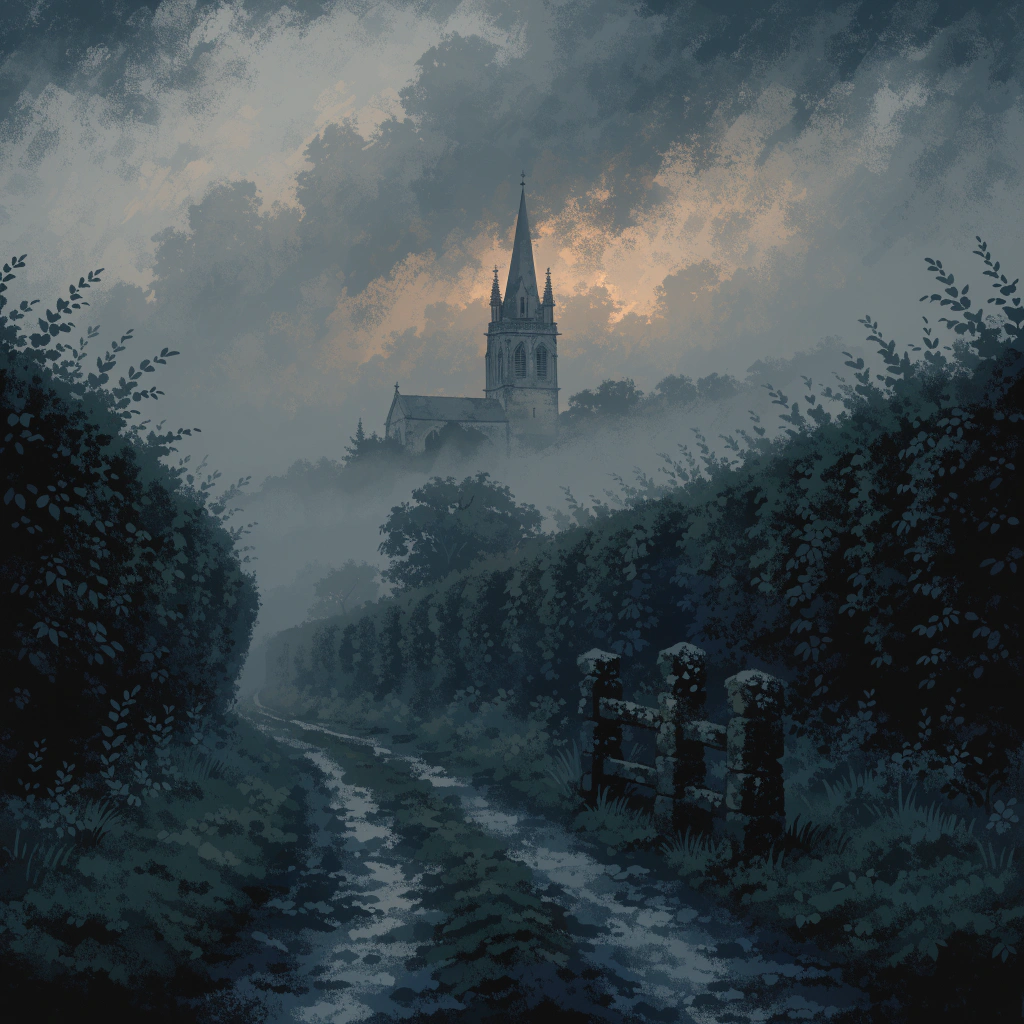
The lane narrows. The hedges have grown high enough that you can't see over them, and the light has gone that particular late-September gold which means you've got about twenty minutes before it's properly dark. Somewhere ahead there's a church, a handful of houses, and people whose families have been here rather a long time.
Nothing has happened. Nothing is going to happen for another forty pages.
You're already uneasy, and that's the whole trick.
What Is Folk Horror?
Not a Monster Problem
Folk horror is the genre that frightens you with a landscape and a calendar instead of a creature. There's no wolfman lurching out of the fog, no haunted mirror, no basement you shouldn't go into. There's a village, a custom, a date circled on the parish noticeboard, and a growing sense that everyone around you has already agreed on something you haven't been told.
It's horror made of geography and habit. Which sounds gentle until you're in it.
You'll know you've found it by feel more than by definition, but three signals give it away almost every time. First: you can't leave — not because a door is locked, but because the bus doesn't come, the road floods, the fog rolls in, or leaving would be terribly rude. Second: everybody else knows. There's a shared understanding humming just under the small talk, and you're the only one who hasn't been briefed. Third: the land has opinions. The hill, the stones, the field with the odd name — they're not scenery. They're participants.
An Obligingly Haunted Island
Britain is almost unfairly well-suited to this. The island has been continuously lived-in for thousands of years, and every one of those years left something behind — a burial mound, a boundary stone, a holloway worn a metre deep by feet that stopped walking it centuries ago. You cannot dig a garden here without turning up somebody's past.
Then there's the layering. A Norman church built on a Saxon site built on something older that nobody bothered to write down. Customs that survived not because anyone believed in them, but because stopping felt like tempting fate. The result is a country where the old and the ordinary sit on top of each other, and the seam between them is exactly where folk horror likes to work.
We don't have to travel far for an example. Head south-west from the shop and you'll reach the Stiperstones, that spine of jagged quartzite outcrops running along the ridge. The largest of them is called the Devil's Chair, and local tradition holds that the Devil scattered the stones there when his apron strings broke — he'd been carrying them from Ireland to fill in a place called Hell's Gutter. There's a grimmer version in which he returns at the winter solstice to gather witches and imps and choose their earthly ruler. And there's a prophecy that if the Stiperstones ever sink from view, England falls.
Better still, there's Wild Edric. A Saxon nobleman who resisted the Normans after 1066, he's said to have been cursed underground along with his men and his fairy wife, Godda, condemned to wait in the old lead workings until England is in genuine danger — at which point they ride. Sightings were reported before the Crimean War. And before the First World War. And before the Second.
That is a complete folk horror plot, sitting quietly in a Shropshire hillside, requiring no adaptation whatsoever.
Fun Fact Cauldron: Much of what we know about Shropshire's folklore comes from Shropshire Folk-Lore: A Sheaf of Gleanings, published in 1883 — over six hundred pages of local belief, custom and strangeness. It was begun by Georgina Frederica Jackson, who had to abandon her fieldwork after falling seriously ill, and finished by Charlotte Sophia Burne, who added her own collection and saw it into print.
Burne went on to become the first woman to preside over the Folklore Society — and, as it happens, the first woman to preside over any learned society in Britain. The definitive record of our county's uncanny was assembled by two women who simply went out and asked people. We think that deserves more than a footnote.
The Four Ingredients
If you want a checklist, folk horror runs on four things, and the good stuff uses all of them.
Community versus outsider
Somebody arrives who doesn't belong. A teacher, a policeman, a folklorist, a family from the city who've bought the old rectory for a song (they always get it for a song, and it's never a bargain). The horror isn't that the locals are monstrous — it's that they're perfectly reasonable people operating on a set of rules the newcomer was never handed.
Ritual and tradition
Something is done every year because it has always been done every year. Nobody can quite explain why, and asking is the fastest way to mark yourself as an outsider. The most chilling line in the genre isn't a threat; it's a shrug.
The land remembers
The field that won't grow. The wood people don't walk through after dark. In folk horror, geography holds a grudge — the past isn't a memory but a pressure, still pushing up through the topsoil like a stone the plough keeps finding.
Slow dread
And crucially, nothing jumps out at you. Folk horror doesn't do the sudden bang; it does the long, patient tightening, the accumulation of small wrongnesses until you look up and realise the exits have quietly closed. If jump-scare horror is a shout, this is a hand on your shoulder that has been there for some time.
The critic Adam Scovell put it more elegantly in his 2017 book Folk Horror: Hours Dreadful and Things Strange, describing what he calls the folk horror chain: landscape, then isolation, then skewed morals, then — inevitably — the happening. Once you've seen the chain, you can't unsee it. Apologies in advance.
Older Than Its Name
Here's the pleasing wrinkle: folk horror is a great deal older than the phrase we use for it.
The literary roots run deep into the late Victorian and Edwardian period. Arthur Machen, born in Caerleon in 1863, spent a career writing about the Monmouthshire countryside — a landscape he preferred to call by its medieval Welsh name, Gwent — as a place where something very old is only barely covered over. The Great God Pan arrived in 1894, The White People in 1904, and both are essentially about the thinness of the ground beneath us.
M. R. James was doing adjacent work, sending mild academics into the English countryside to find objects they really should have left alone. Later, Susan Cooper would pour the same material into children's fiction, which is why a certain generation of British readers grew up with a permanent low-level suspicion of standing stones.
Then came the 1970s, and the genre found its face. Three British films are usually named together as the founding trio: Witchfinder General in 1968, The Blood on Satan's Claw in 1971, and The Wicker Man in 1973. Television was busy too — Robin Redbreast, The Stone Tape, A Warning to the Curious, all landing in British living rooms and quietly rewiring a nation's relationship with the countryside.
Fun Fact Cauldron: Nobody was making "folk horror" in 1971, because the term didn't exist yet. Piers Haggard, who directed The Blood on Satan's Claw, used the phrase in an interview around 2004 — looking back at his own film some thirty years after the fact. It stuck properly in 2010, when Mark Gatiss grouped those three films together in his BBC documentary A History of Horror.
A genre named in retrospect, by the people who'd accidentally invented it. Very folk horror, that: the meaning arrives long after the ritual.
The genre never really went away, but it came back with force. Ben Wheatley's Kill List in 2011 and A Field in England in 2013, Robert Eggers' The Witch in 2015 — proof that a muddy field and a bad idea remain a reliable source of dread.
Where To Begin
A starter pack, then, sorted by how much you'd like your evening ruined.
Gentle entry
- Susan Cooper, The Dark Is Rising — folk horror with the volume turned down and the snow turned up. Ostensibly for children. Absolutely not only for children.
- Alan Garner, The Owl Service — a Welsh myth insists on being re-enacted by three modern teenagers who would very much rather it didn't. Short, strange, and it never quite lets go.
Classic essential
- Arthur Machen, The White People — a young girl's diary, and one of the most genuinely unsettling things in English literature. Read it in daylight. We're not joking.
- M. R. James, the collected ghost stories — the polite, dusty end of the genre, where a man finds a whistle and immediately regrets everything.
- Shirley Jackson, The Lottery — American rather than British, but the definitive short story about a village doing something because it has always done it.
Modern unsettling
- Andrew Michael Hurley, The Loney — a bleak stretch of Lancashire coast, a religious pilgrimage, and a rising certainty that this will not end well.
- Andrew Michael Hurley, Starve Acre — grief, a Yorkshire field, and something in the soil. Slim, and it lands like a stone.
- Francine Toon, Pine — the Scottish Highlands, a missing woman, and a child who notices far too much.
- Lucie McKnight Hardy, Water Shall Refuse Them — a Welsh village in the drought summer of 1976, curdling nicely.
- Zoë Gilbert, Folk — linked stories from an island where the old customs are still very much running. Beautiful, and quietly barbed.
Not too scary
- Frances Hardinge, Cuckoo Song — a changeling story set in the 1920s, written with such warmth that you almost don't notice how eerie it is.
- Catriona Ward, Little Eve — a remote Scottish island and a family with beliefs of its own. Heavier than the others here, but the writing carries you.
Ritual Reads Recommends: Start with The Owl Service, then read Starve Acre. One is a myth breaking out of a dinner service in a Welsh valley; the other is a hole in a Yorkshire field. Fifty-odd years apart, and they're plainly haunted by the same thing.
Read back to back, they'll teach you the shape of the genre faster than any essay — this one included.
Mind How You Go
The pleasure of folk horror isn't really fear. It's attention. Once you've read a few of these, you start noticing the odd field name on the map, the lane that bends for no visible reason, the fact that your village fete has a tradition nobody can date. Shropshire obliges enormously here.
None of it means anything, of course. Wild Edric is not going to ride out of the Stiperstones this autumn, and the Devil's apron strings held perfectly well. But the stories stayed, generation after generation, because they were worth keeping — and a country that keeps its strange stories is a country worth walking through slowly.
So: which one got you? The lane you'd rather not use after dark, the ruin your grandmother told you about, the thing your family does every year without ever explaining why? Come and tell us over a coffee — we're building a folk horror table for October, and we'd like the local entries to be genuinely local.
Bring the story. We'll find you the book.
Stay connected with Ritual Reads
Be the first to hear about newly conjured titles, upcoming gatherings, and curated recommendations from our shelves.
Community voices
What our future community is saying.