
Why Fog Feels Gothic: The UK Landscape as a Genre Machine
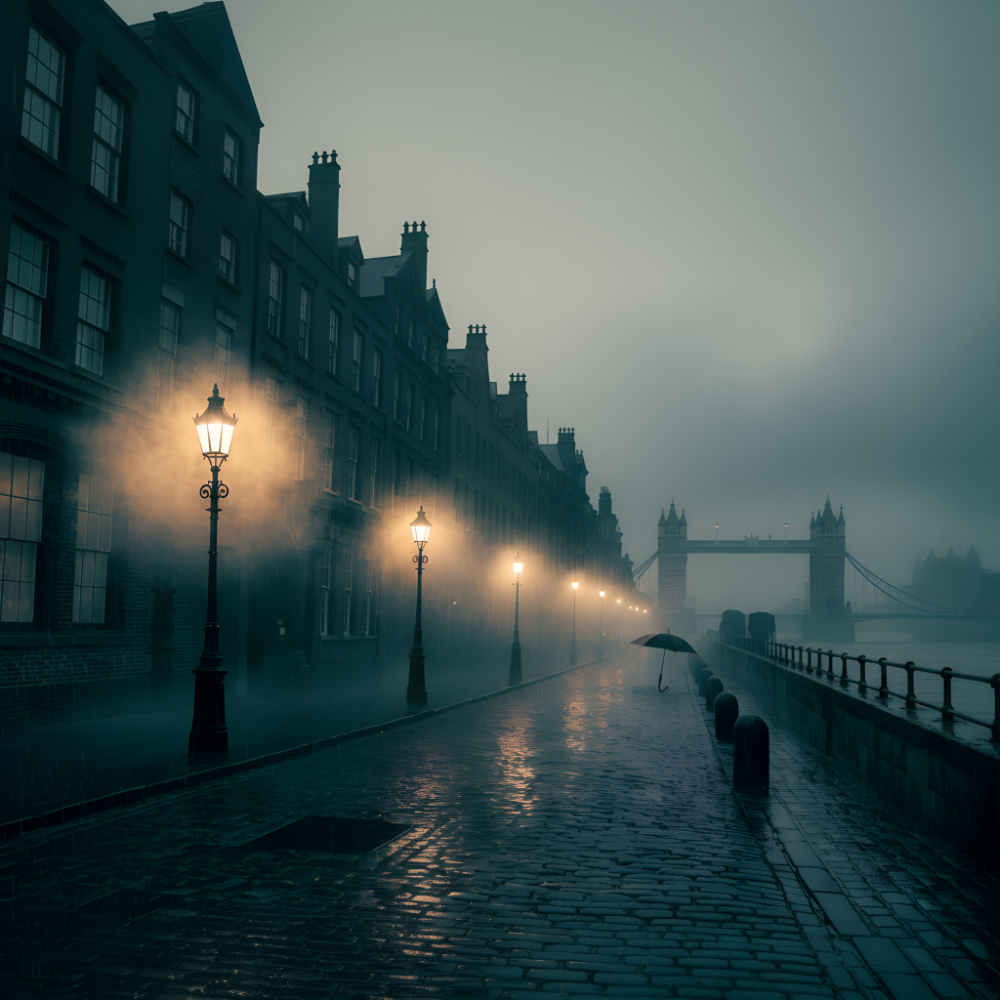
The fog doesn’t announce itself. It arrives like a rumour—first a softening at the edges of things, then a slow erasure. Lampposts lose their tops. The end of the street simply stops existing. Somewhere behind you, footsteps fall at a rhythm that doesn’t quite match your own.
If you’ve ever walked through a proper British fog—the kind that turns Big Ben into a dark silhouette and reduces Tower Bridge to a spectral outline barely distinguishable from the sky—you already know this feeling in your bones. It’s not just the weather. It’s atmosphere in the most literary sense of the word: a filter that edits what you can see and hear, turning an ordinary lane or field into a stage set for hauntings. Fog is, simply, the UK’s most reliable Gothic machine. Add moisture, subtract visibility, and suddenly the past is standing in the road.
That is what we’re here to talk about. Not fog as a meteorological curiosity (though we’ll get to some delightful facts), but fog as a storytelling device—a portable generator of dread that British and Irish writers have been plugging into their fiction for centuries. From London’s coal-choked alleyways to the salt-haunted headlands of the North Sea, the UK’s landscapes don’t just host Gothic stories. They are Gothic stories, waiting for the weather to turn.
The Craft of Fog
Let’s get into the mechanics. Because fog doesn’t just look creepy—it operates on your senses in very specific ways that happen to align perfectly with what Gothic fiction needs to do.
What you can’t see becomes the threat. Fog is, by the Met Office’s sober definition, visibility reduced to under 1,000 metres. That’s the clinical version. The Gothic version is this: every shape beyond arm’s reach becomes a suggestion. A lamppost might be a figure. A figure might be nothing at all. On moors and marshes, fog hides paths and landmarks so thoroughly that even characters who know the landscape “often miss their road” and risk wandering into treacherous ground. The danger is there—you just can’t prove it. And that uncertainty? That’s the engine of dread.
The familiar becomes uncanny. London eyewitness accounts from the late nineteenth century describe how fog altered colour and light in ways that “bear little resemblance” to normal atmosphere, producing strange chromatic effects—yellowish, greenish, sometimes almost amber. Streets you’ve walked a thousand times suddenly look like a half-remembered dream of themselves. Your own front door seems slightly wrong. And it’s not just visual: fog distorts sound, too. Footsteps land closer or further than they should. Voices appear without visible bodies. (Which is, if we’re being honest, one of the most unsettling sentences in the English language.)
The world shrinks to a pocket. Sea fogs and radiation fogs can be hyper-local, hugging a single valley or coastline while the next town over sits in sunshine. That means fog can trap characters in a little white-walled chamber of the world. Sightlines collapse. Sound is muted to a whisper. A person can vanish by stepping just a few metres away. This is isolation rendered in water vapour—no locked doors required.
The present dissolves into the past. Here’s the one that really gets us. When fog dims the light and muffles modern noise, it erases the details that anchor you in the twenty-first century. Cars, glass shopfronts, neon signs—all gone. What remains seems older, quieter, gaslit. In London, even contemporary fog triggers Victorian imagery, as if the city’s coal-smoke past is baked so deeply into its identity that any reduction in visibility summons it back. At the coast, lighthouses and harbour walls already belong to centuries of wrecks and legends. Add fog, and you get the unmistakable sensation that the past is seeping back in from sea and sky.
Fun Fact Cauldron: London’s infamous “pea-soupers” weren’t just thick—they were colourful. Late-nineteenth-century observers described the fog as hanging along the Thames embankment like a “yellow silken scarf,” with shifting hues that transformed the city into something closer to an Impressionist painting than a functioning metropolis. The Great Smog of 1952 was so dense it killed thousands and led directly to the Clean Air Act of 1956.
London: Gaslight & Narrow Lanes
Start with the city, because London invented a particular flavour of Gothic fog that the rest of the world has been borrowing ever since. Historic London fog was dense, yellowish, and polluted—a noxious cocktail of coal smoke and Thames damp that swallowed electric and gas light into halos and turned the embankment into something from a fever dream. Narrow lanes, tall buildings, and that thick, light-eating murk created tunnelled, almost claustrophobic spaces where sound echoed unpredictably and shadows moved at their own pace.
This is urban Gothic at its finest: a city that appears complicit in its own crimes. The fog doesn’t just hide wrongdoing; it collaborates. Class divides, buried secrets, and the sheer uncanny weight of a metropolis built on centuries of the dead—all of it thrives when you can’t see more than ten feet ahead. Even today, fog over the Thames and around the Tower reduces London’s most familiar landmarks to ghostly outlines, and the effect is still, frankly, magnificent.
The Moors: Wild & Unforgiving
Now step out of the city entirely and onto the moors—those rolling, peaty highlands where the sky is enormous, and the weather has opinions. Gothic criticism describes the moors as both refuge and threat: spaces that allow “ramblings of youthful freedom” while constantly reminding you that death, violence, and ungovernable forces of nature lurk just around the corner. (Cheerful stuff.)
The paradox of the moor in the fog is beautiful and terrible. You’re standing in one of the most open landscapes in Britain, yet you can see almost nothing. You seem at once vulnerable and confined. The land stretches endlessly in every direction, but your world has been reduced to a circle of grey perhaps twenty paces wide. Snowstorms and mists can disorient even locals, and the risk of wandering into boggy ground is very real. The moor setting supports narratives about obsession, revenge, and feral emotion because the land itself seems to mirror inner turmoil—vast, wild, and utterly indifferent to your survival.
The Marshes: What Won’t Stay Buried
Marshes are the moor’s wetter, more treacherous cousin—and they come with a deeply unsettling metaphorical toolkit. Think bog bodies. Think treacherous ground that looks solid until it isn’t. Think secrets that refuse to stay underground, no matter how deep you bury them.
Fog over marshland does something visually extraordinary: it erases the line between land and water. You can’t tell where solid ground ends and the sucking murk begins, which is precisely the kind of landscape detail that Gothic writers dream about. The air is damp and chill, the sound gets absorbed into the reeds, and the whole place feels porous and unstable—as if the earth itself might betray you mid-step. Marshes are ideal for stories about family histories that won’t stay submerged and bodies (literal or metaphorical) that keep surfacing no matter what.
The Coast: Salt, Stone & Sirens
Coastal fog—known as “haar” along the North Sea—is its own breed of atmospheric menace. It forms when warm, moist air rolls over colder sea surfaces, creating a low, dense blanket that hugs the shoreline and can cascade over cliffs like a soft, ethereal waterfall. Day can feel like premature night. The world beyond the harbour wall simply ceases to exist.
Gothic scholarship positions the coast as a liminal zone: the beach is where shipwrecks happen, where ghosts of mariners emerge, where the sea alternates between punisher and the shore as protector. Lighthouses, harbour walls, and fog signals give you built-in imagery of warning and guidance that might fail—a foghorn calling through the murk to ships that may or may not hear it. There’s something deeply Gothic about a light designed to save lives that the fog can swallow whole.
Fun Fact Cauldron: The word “haar” for coastal fog comes from an Old English or Dutch root and is still used along the eastern coasts of Scotland and England. Haar is so localised that one side of a coastal town can be wrapped in thick fog while the other enjoys clear skies—making it the ultimate Gothic party trick of selective concealment.
Gothic DNA, Fog-Delivered
If you’ve been following our earlier deep dive into what makes Gothic literature Gothic, you’ll recognise these landscapes hitting every pillar of the genre’s DNA. Atmosphere? All four settings deliver it in buckets—from London’s chromatic smog to the salt-wet haar of the North Sea coast. Confinement? Alleyways compress space, fog shrinks visible distance on moors, and coastlines trap characters between sheer drops and a blank, roaring sea. Secrets? Marshes hide bodies, cities hide crimes, coastal towns harbour wrecks and drowned histories. Dread? Reduced visibility plus unstable ground plus the raw power of the sea equals a constant low-grade fear that something is out there just beyond perception. And the past pressing in? Victorian fog lore, Brontë-inflected moors, old smuggling routes, centuries of shipwreck legend—every one of these landscapes bleeds historical resonance into any present-day scene.
Fog is, in the end, the quickest way to layer Gothic DNA over any British landscape. It’s a one-ingredient recipe for the uncanny.
Shelf-Ready: Reads Sorted by Landscape
Time to stock your reading pile. We’ve grouped these by the landscape mood they conjure—pick your preferred flavour of atmospheric dread and dive in.
Urban Fog: The Quick by Lauren Owen delivers a Gothic vampire thriller with ferocious London energy, building a secret shadow city layered over gaslit Victorian streets. For the classic anchor, any Dickens fog sequence will do, but Arthur Conan Doyle’s The Hound of the Baskervilles bridges city and moor beautifully—Holmes starts in fog-choked London before the investigation pulls him onto haunted Dartmoor.
Moorland Dread: Start with Emily Brontë’s Wuthering Heights, the defining moorland Gothic, where Yorkshire’s harsh landscape mirrors violent passion so completely that weather and emotion become indistinguishable. Katherine Clements’ The Coffin Path is a superb contemporary companion—a remote farmhouse, creeping strangeness, and a moor that feels spiritually charged. Susan Hill’s The Mist in the Mirror turns fog and desolate moorland into characters in their own right, and Bella Ellis’s The Vanished Bride casts the Brontë sisters themselves as detectives against that same brooding Yorkshire backdrop.
Marsh & Fen: This is the category begging for your own discoveries—Gothic marshland fiction is ripe territory. Use the critical logic of sinking ground and surfacing secrets to guide your picks, and let us know what you find.
Coastal Gothic: Bram Stoker’s Dracula gives you the Whitby sections—abbey ruins above, harbour walls below, and local legends of bells heard at sea when ships are lost. The count’s arrival during a storm is coastal Gothic perfection.
Ritual Reads Recommends: The Coffin Path by Katherine Clements — If you want moorland Gothic that feels both ancient and bracingly modern, this is your book. A woman alone in a remote farmhouse, strange happenings on the path outside, and a Yorkshire moor that practically breathes down your neck. Perfect for a foggy evening read.
Your Foggy-Night Reading Ritual
Because we believe the right reading conditions are half the magic, here’s how to build the perfect fog-themed evening:
The brew. A strong Yorkshire tea or a dark, smoky Welsh Gold—the kind of cup that crime writers and Gothic essayists agree pairs with “the loam in the air” and low clouds. If you’re feeling indulgent, swap tea for a glass of something red and heavy.
The light. Low and warm. A single lamp with an amber bulb, a candle or two, or a shaded reading light that pools gold onto the page and leaves the corners of the room in proper shadow. We’re going for gas lamp pools against darkness, not operating-theatre brightness.
The sound. Match your book’s landscape. For coastal reads: soft ambient ocean and a distant foghorn. For moor and marsh: wind, the occasional bark of a far-off dog, and the suggestion of rain. For urban Gothic: muffled city sounds, the ghost of carriage wheels, footsteps on wet cobblestones. (There are ambient soundscape playlists for all of these. We checked.)
The setting. If you can, read near a window on a misty or rainy night. Let the real weather collaborate with the fictional kind. If the sky won’t cooperate, a humidifier and lowered blinds can fake it surprisingly well. (We regret nothing.)
And there you have it—everything you need to let a good British fog do what it does best: turn an ordinary evening into something that feels like the opening chapter of a novel you can’t put down. The mist will handle the atmosphere. The tea will handle the warmth. All you have to do is pick a book, kill the overhead lights, and trust that whatever just shifted in the corner of your vision was probably the cat. Probably.
Stay connected with Ritual Reads
Be the first to hear about newly conjured titles, upcoming gatherings, and curated recommendations from our shelves.
Community voices
What our future community is saying.